
🐺 When Did Dogs Become “Dogs”?
Highlights
#The reduction in dogs’ brain size happened much later than previously thought—around 5,000 years ago—indicating that early domestication did not immediately produce major biological changes.
#Dogs are not cognitively “inferior” to wolves; their intelligence has been reoriented toward social and interspecies communication, especially the ability to read human cues and intentions.
#Domestication appears to be a gradual, multi-phase process shaped by human societal changes, where dogs evolved not through simple loss, but through adaptation to life in close relationship with humans.
Brain size, domestication, and a shift in intelligence
For a long time, the story seemed straightforward: as wolves became dogs, they lost something. Smaller bodies, smaller brains, diminished capacities. Domestication was often framed as a kind of simplification.
Recent research complicates that narrative in important ways. A study led by Thomas Cucchi and colleagues shows that the reduction in canine brain size did not occur at the beginning of domestication, but much later—around 5,000 years ago, well into the Neolithic period. This temporal shift forces a reconsideration of what domestication actually entails.
The study is based on a large comparative dataset of CT scans, including prehistoric wolves and dogs dating from 35,000 years ago to the present, alongside modern wolves, breed dogs, village dogs (ranging free dogs), and dingoes.
When these skulls are analyzed across time, a clear pattern emerges:
Early canids living near humans—often referred to as “protodogs”—do not show reduced brain size compared to wolves
Significant reduction appears only in later populations associated with settled human societies
Modern dogs, across different categories, show on average a markedly smaller brain volume than both ancient and modern wolves
This alone challenges the assumption that brain reduction is an immediate byproduct of domestication. Instead, it suggests that domestication unfolds in phases, and that different traits emerge under different ecological and cultural conditions.
One of the most striking implications is that early human–canine relationships may not have been as tightly integrated as we often imagine. The absence of reduced brain size in early protodogs indicates that the full “domestication syndrome” was not yet in place. This points toward a prolonged period of loose coexistence rather than immediate dependency or control.
In other words, the first dogs may not have been “ours” in any strong sense. They lived alongside humans, but not yet fully within human systems.
The question then shifts: if brain reduction is not the starting point, what does it correspond to?
Several hypotheses emerge, and they are not mutually exclusive.
One concerns energy and ecology. As humans transitioned into agricultural and village-based societies, food resources became structured but also limited and unevenly distributed. Smaller bodies require less energy; smaller brains, despite their functional importance, are metabolically costly. In such environments, selection may have favored animals that could thrive on lower caloric intake, leading indirectly to reduced brain size.
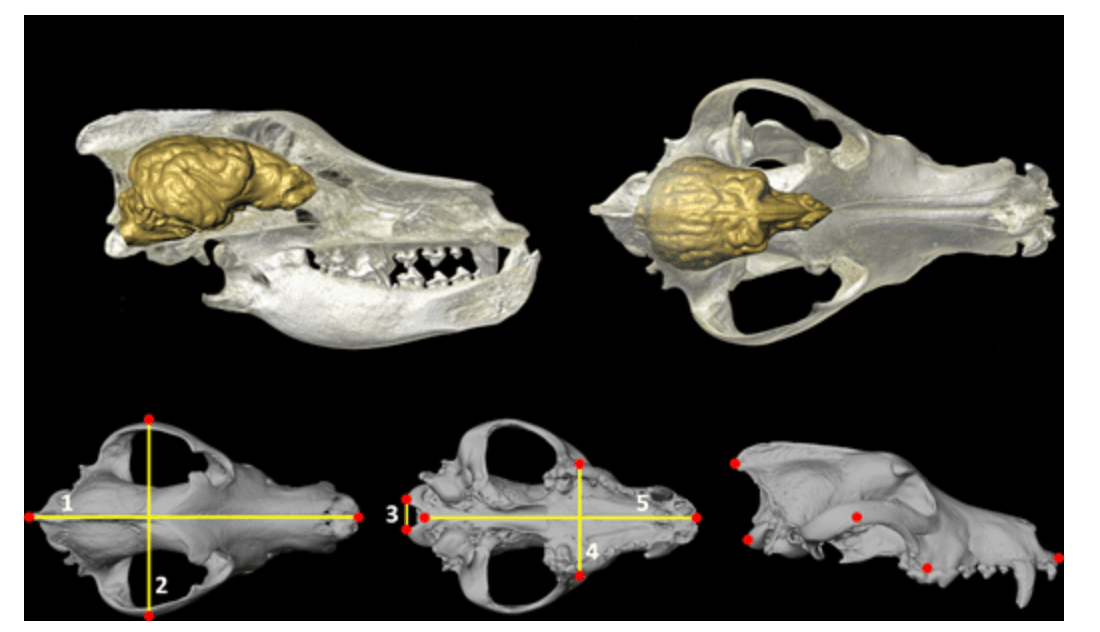
Another concerns functional reorganization. A smaller brain is not simply a diminished one. Neurological research suggests that reductions in size are often accompanied by changes in internal organization and prioritization. In dogs, this may have involved a shift away from the demands of independent survival—long-distance navigation, autonomous hunting strategies, complex environmental mapping—toward capacities more relevant within human proximity.
These include:
heightened sensitivity to social cues
rapid interpretation of gestures, gaze, and vocal tone
increased responsiveness to human attention and emotional states
In this light, domestication appears less as a process of cognitive loss and more as a process of cognitive redirection.
Cucchi emphasizes this point clearly: dogs are not less intelligent than wolves. They are differently intelligent. Their abilities are not diminished, but tuned toward a different kind of environment—one in which survival depends not only on the landscape, but on interspecies interaction.
This distinction becomes even more relevant when considering contemporary dogs. As Cucchi notes, modern living conditions often do not allow dogs to fully express their cognitive capacities. What we perceive as a limitation may, in part, reflect constraints: environments that restrict exploration, problem-solving, and autonomous decision-making.
The reduction in brain size, then, should not be read as a linear marker of decline. It is better understood as part of a broader reconfiguration that took place over thousands of years, in parallel with profound transformations in human societies.
This also reframes domestication itself. Rather than a single event or a simple directional process, it appears as a long, dynamic entanglement shaped by:
changing human settlement patterns
ecological pressures
mutual adaptation between species
From this perspective, the dog is not a simplified wolf, but a new kind of being altogether—one whose cognitive world is structured around relationships.
The deeper implication is that intelligence cannot be meaningfully assessed in isolation from context. Wolves and dogs inhabit different perceptual and social environments, and their cognitive systems reflect those environments. To compare them purely in terms of size or even raw problem-solving ability risks missing the specificity of each.
What emerges instead is a more relational understanding of intelligence. In dogs, cognition is not only about navigating the physical world, but about navigating us.
Citation
Thomas Cucchi, et al. "Brain size reduction in dogs was already established at least by the Late Neolithic of Western Europe, 5000 years ago". R Soc Open Sci. 1 April 2026; 13 (4): 252453. https://doi.org/10.1098/rsos.252453
Voices From The Community is a special section of our blog written by people like you, for people like you. If you want to propose your contribution to our AEDC Blog, check this page here.
🌟🐕🌈 More on dogs, wolves, people and nature? Check the AEDC Academy!

Hey there! Here is Marco Adda. Welcome on my blog-post. Here at AEDC - Anthrozoology Education Dogs Canines, you find relevant informations about dogs, wolves, other animals and their interaction (and conflict) with people.
Subscribe to our newsletter


VOICEs FROM THE COMMUNITY Program:
Write your Wolf/Dog/Animal story and publish it on our AEDC Blog.
Your voice is our strenght.


15% OFF
on our programs?
GET YOUR CODE RIGHT AWAY
We will not send spam messages
Follow on


AEDC Anthrozoology Education Dogs Canines - Academy
Supporting professionals.
Shaping the life of people and animals.
© Copyright 2026 | Marco Adda | Privacy Policy | Terms of Use
Created with © Systeme.io